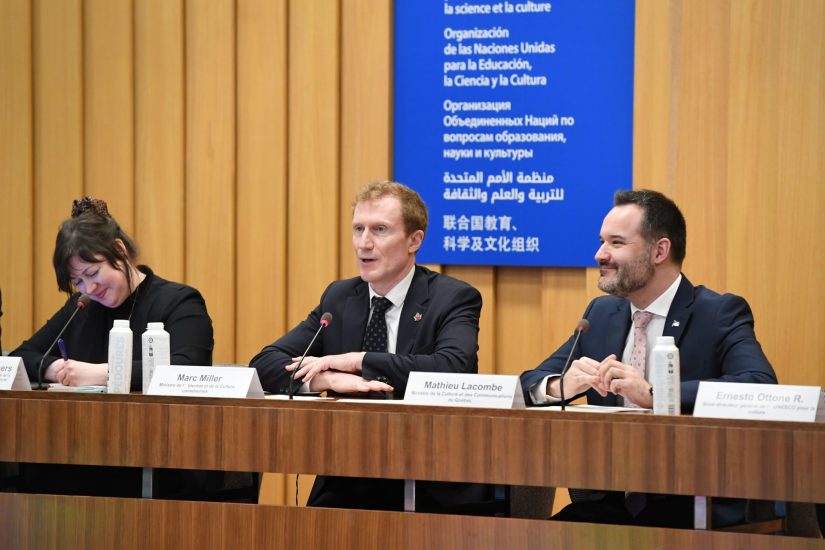
On the occasion of the 19th session of the Intergovernmental Committee of the 2005 UNESCO Convention, taking place in Paris from February 17 to 20, 2026, near-unanimous support — including from the governments of Québec and Canada — was expressed in favour of adopting an additional protocol aimed at strengthening the implementation of the Convention in the digital environment. The Coalition for the Diversity of Cultural Expressions (CDCE), participating in the discussions through the International Federation of Coalitions for Cultural Diversity (IFCCD), welcomes this major development, driven by sustained engagement from civil society in Canada and internationally.
This decision represents an important first step: the protocol must now be formally adopted by the Conference of Parties to the Convention and subsequently undergo the approval processes required within the United Nations system.
In a context of rapid technological change, particularly linked to the development of generative artificial intelligence, the CDCE recalls that this future protocol must pursue a clear objective: to protect and promote the diversity of cultural expressions and ensure that human creativity remains at the heart of digital cultural ecosystems. It is essential that international normative frameworks evolve in step with ongoing transformations, without weakening creators’ rights or States’ ability to implement ambitious cultural policies.
Representing more than 350,000 creators and over 3,000 cultural enterprises across the country, the CDCE contributed actively to the discussions by submitting a formal brief and organizing, in Paris, a side event focused on the interface between culture and the digital environment in recent normative instruments. This mobilization forms part of a broader collective effort, coordinated with the IFCCD, which brings together coalitions across several continents to defend and advance the objectives of the 2005 Convention.
The CDCE underscores Québec government’s leadership and Canada’s strong collaboration, which played a decisive role in advancing the discussions and upholding the principles of the Convention. The presence of Mathieu Lacombe, Québec’s Minister of Culture and Communications, and Marc Miller, Minister of Canadian Identity and Culture, reflects the strategic importance attached to these issues.
- Related publications
-