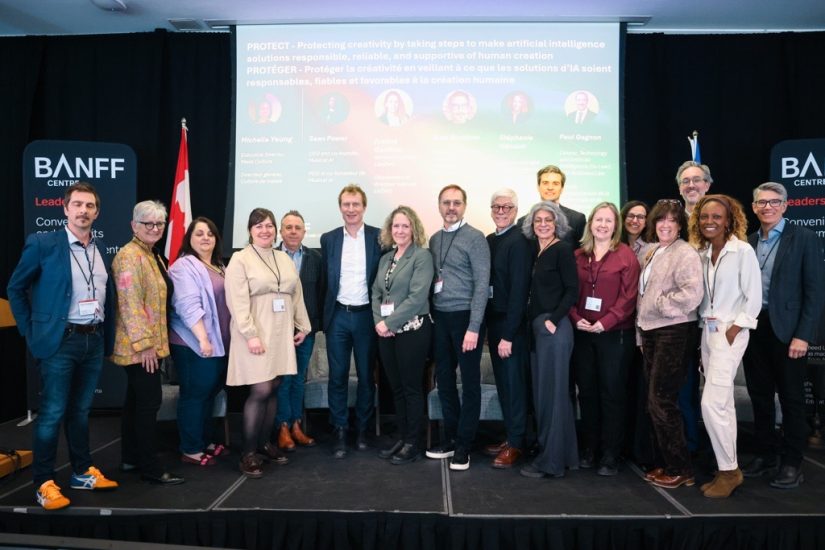
Banff, March 18, 2026 – The Coalition for the Diversity of Cultural Expressions (CDCE) took part in the National Summit on Artificial Intelligence and Culture, held on March 16 and 17, 2026, in Banff, Alberta. The event was organized by the Government of Canada in collaboration with the Banff Centre for Arts and Creativity.
The Summit took place in the presence of the Honourable Marc Miller, Minister of Canadian Identity and Culture, and the Honourable Evan Solomon, Minister of Artificial Intelligence and Digital Innovation. It brought together stakeholders from the cultural, technological, and academic sectors, alongside government representatives, to advance discussions on the relationship between artificial intelligence and culture.
Encouraging signals were sent, and the Coalition intends to continue its advocacy efforts to secure clear commitments for our sovereignty within the National AI Strategy.
Establishment of an Advisory Committee on AI and Culture
The announcement of the creation of an advisory committee on culture and AI is welcomed by the Coalition. CDCE members are already stepping forward to participate.
Encouraging messages
Minister Miller stated that he does not intend to “reopen the Copyright Act” and reaffirmed that creators must be remunerated for the use of their works. These statements are encouraging responses to the demands consistently expressed by CDCE members throughout the Summit.
Marie-Julie Desrochers, Executive Director of the CDCE, and Andrea Kokonis, Co-Chair of the Coalition and Chief Legal Officer and General Counsel at SOCAN, delivered keynote remarks in the “Protect” segment, which focused on the conditions required to ensure responsible, trustworthy AI that respects human creativity.
They reiterated the principles advanced by the CDCE and its members, structured around the three ART pillars — Authorization, Remuneration, Transparency:
- Authorisation is required for the use of copyright-protected works
- Enabling the development of a licensing market in order to remunerate rights holders
- Impose transparency obligations, including disclosure of the content used to train AI systems and the identification of AI-generated content.
These messages reflect a clear objective: recognizing intellectual property as a strategic resource essential to Canada’s cultural sovereignty.
Read the speech View the presentation
The CDCE’s contribution was also reflected in the active participation of several of its members across different segments of the Summit, bringing forward perspectives from the music, publishing, audiovisual sectors, and Francophone minority communities.
A call for clear commitments for the cultural sector
“We are encouraged by what we heard at the Summit, but we remain concerned by the lack of firm commitments to our sector. Canada has long been a leader in protecting and promoting the diversity of cultural expressions in the digital environment, and this must continue. We hope the national AI strategy will go further, particularly through concrete commitments on transparency and support for the development of a licensing market and solutions that respect copyright,” said Marie-Julie Desrochers, Executive Director of the CDCE.
The Coalition will continue its efforts to ensure that public policies on artificial intelligence fully recognize the value of human creativity.
- Related publications
-